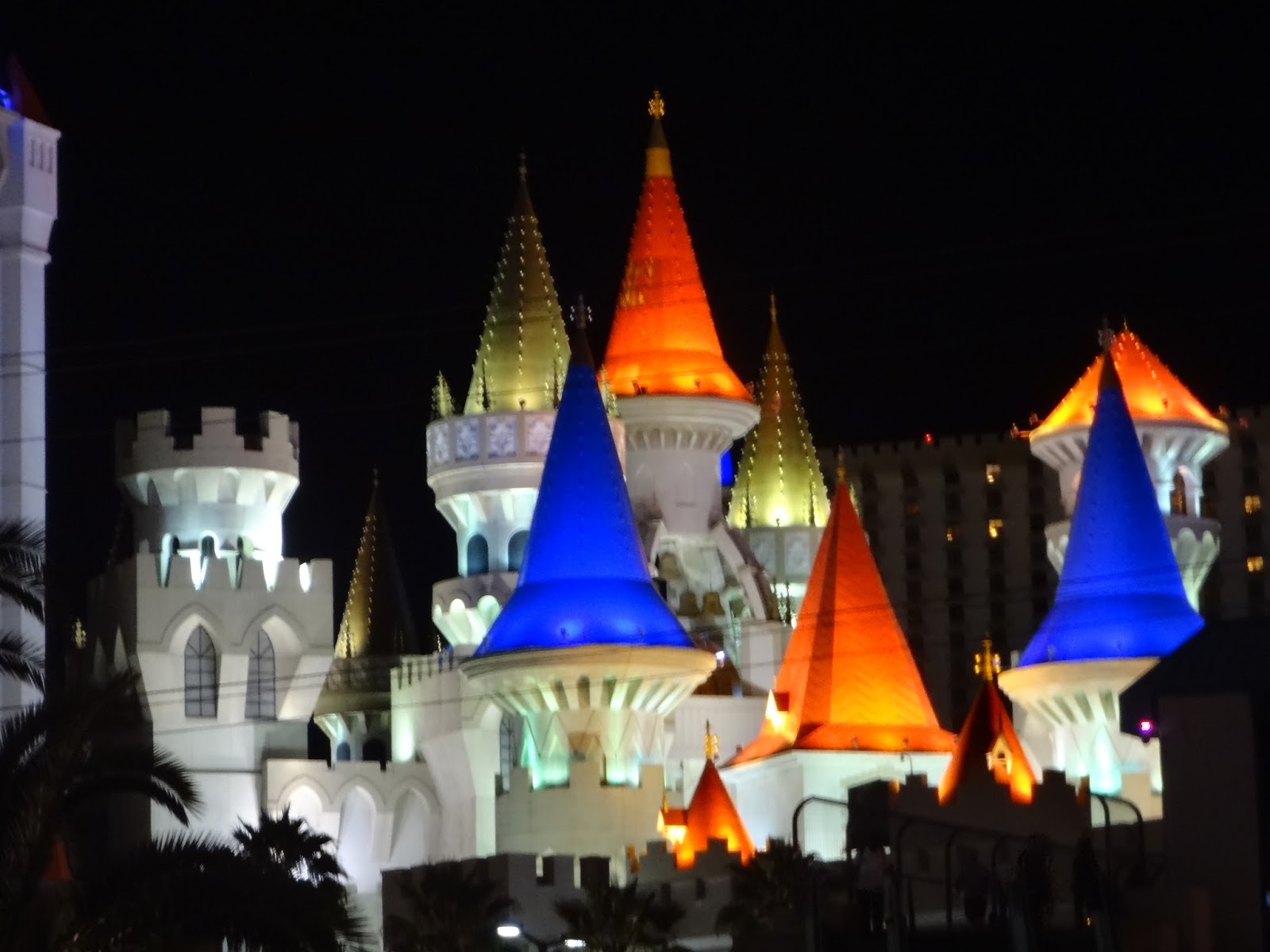
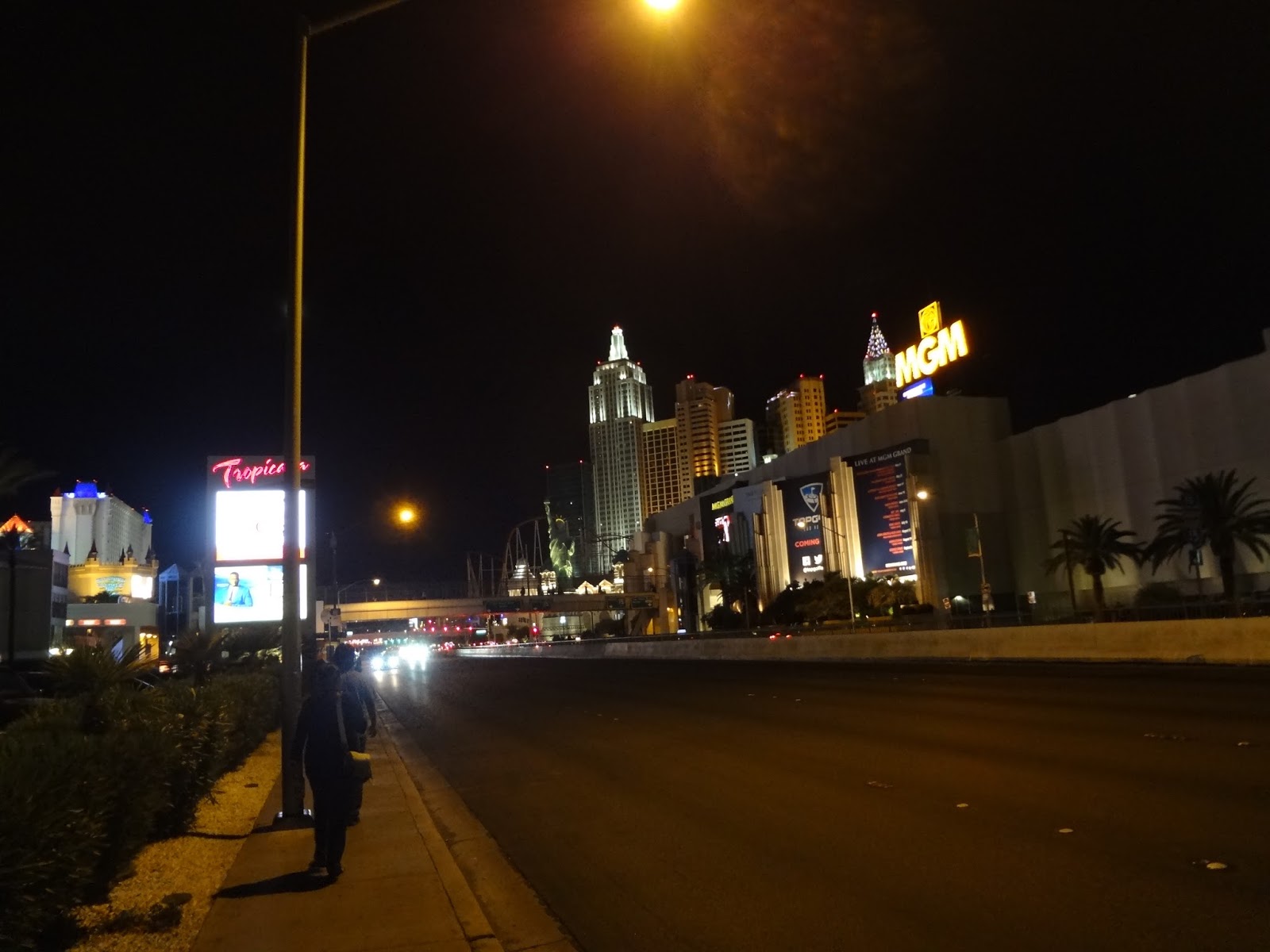
As our flight started its descent over Las Vegas, I was dazzled by the lights below. Lights glittered all over like a huge, sprawling net. Appeared to be laid out for the aircraft to land on it like a trapeze artist. I frankly admit that I have never seen such a myriad of lights before. Not even when our plane hovered over glittering Manhattan while on its descent at New York JFK. Our son Arjun had already fixed up a car with a rent-a-car centre. We were transported there in shuttle service available from Terminal 1 of McCarran International Airport. Arjun completed the formalities with the car company, and then we drove towards the city centre with Arjun at the wheel. After a short drive, we were at the famous Las Vegas Strip. I must admit that the Strip looks vibrant and fascinating at night, more than any other place I have seen on our planet. Like a fairy tale world. Mandalay Bay, Luxor, MGM, Excalibur, New York-New York, and David Copperfield. The illuminated Statue of Liberty in front of New York, New York, and the mediaeval English castle-type architecture of Excalibur's exteriors stand out in a maze of glittering hotels and casinos on the Las Vegas Strip. We stayed two nights at Excalibur, named after the legendary sword of King Arthur, and tried our hands at the casino.
Hoover Dam, Colorado
Started our journey to the Grand Canyon in the morning. Via Boulder City in Nevada, our first halt was at the famous Hoover Dam. Built in the early twentieth century during the Great Depression to tame the Colorado River in the Black Canyon, bordering Nevada and Arizona, it is a showpiece of engineering. The reservoir that formed during the construction of the dam and hydroelectric project is known as Lake Mead, the largest reservoir in America. After going around Hoover Dam and almost gobbling down a hearty American breakfast, we embarked on the final lap of our journey.
Arizona Desert
Soon, we found ourselves whizzing through the great Arizona desert. Dotted with cactus trees, some as large as fully grown banyan trees, replicated images I tried hard to remember from cowboy movies of yesteryear that I had seen as a youngster. These cactus trees took up various sizes and complex shapes when we turned left from the highway and took a shorter route through the desert to reach Kingman for fuelling and refreshment.
Historic Route 66
The route happens to be the historic Route 66, the mother road of America, which came up in the early twentieth century and has remained unspoiled over the years. A very fascinating route, as it retains the character of America during the early 1900s. It leads straight to the Black Mountain. On our way, we saw a very interesting small town, with horses, cars, bikes and a pub, looking like a ranch. To me, it was a captivating sight as it appeared to emerge out of a classic cowboy story. For Kingman, we had to turn right after about an hour’s drive. If we had driven straight, we would have reached the nearest point of the Grand Canyon, i.e., the West Rim. A brief stopover at Kingman for fuelling and delectable bites on American ice cream at the gas station was delightfully refreshing.
Staying in Williams, Arizona: The Gateway to the Grand Canyon
We then drove down to Williams, where we had booked our hotel. A quaint little town, cuteness radiated from every nook and cranny. Right from Highlander Motel, where we stayed, attractive cafes, warm restaurants with live music, gas stations, departmental stores, and the pleasant chill of a hill station all seem to gel so wondrously.
Staying here offers the perfect balance of small-town charm and easy highway access to the surrounding canyons.
A Scenic Detour: Catching a Sedona Sunset via Oak Creek Canyon
After settling down at Williams, we decided to catch the much-hyped sunset at Sedona. As our car climbed up and down the hilly terrain to get to Sedona, it brought us unique vistas of Oak Creek Canyon at the beginning and Red Rock Canyon / Secret Mountain while nearing Sedona. The ride and the views were spectacular and, in parts, formidable! Particularly while negotiating close to the steep canyon walls. Sedona is again a lovely little town beautifully decorated with artistic statues, and watching the sun go down, the mountainous silhouette from Sunset Point was an exhilarating experience. The next morning, we were overtly excited while gearing up for a visit to the Grand Canyon, about 55 miles from Williams. Las Vegas is about 2000 ft above sea level; Williams is about 6000 ft above sea level, and the Grand Canyon is about 7000 ft above sea level. The road distance from Las Vegas to the Grand Canyon is about 290 miles.
Exploring the Grand Canyon South Rim: Tips and Viewpoints
So when we reached the Grand Canyon National Park, we never had an inkling that we had climbed over 5000 ft on our journey from Las Vegas. It was as if driving on plains throughout. The mystery deepened when we took the park-and-ride shuttle bus from the Grand Canyon Visitors Centre.
- I was still desperately trying to figure out how our bus would be negotiating such giant gorges I had seen only in movies and photographs till then when our driver announced that the first viewpoint had arrived. And there it was. As if from nowhere, a spectacular sight opened up and greeted our eyes. It was only then that I realised that we were at an elevation of about 7000 ft above sea level. The immense buttes, some with steep jagged rocky walls running straight down and deep down at the bottom, and the Colorado River winding its way are a real treat for the senses. The formidable vastness of the ravine is breathtaking. Created by the Colorado River, this earth’s wonder evolved a billion years ago, and the current Grand Canyon is said to be six million years old. The South Rim is regarded as the heart of the Grand Canyon.
The Best South Rim Shuttle Bus Viewpoints
The viewpoints covered by the shuttle are the following:
- Trail View Overlook Point & Maricopa Point: Excellent spots to see the winding Bright Angel Trail
- Powell Point & Hopi Point: Celebrated positions for open views and photography
- Mohave Point & The Abyss: Where you can look almost straight down into vertiginous sheer drops.
- Monument Creek Point, Pima Point & Hermit Rest: The final stretches of the western rim route.
On the return path, it stops at Mohave Point and Powell Point. Adventure lovers can take the trail paths to Hermit Rest. A new vista opens up as one moves from one point to another. Those views are vertiginously stunning and beautiful. Shades of red, copper and yellow; deep chasms at places; rocks jutting out in the form of table tops; nature’s architectural wonders, like the formations of temples aptly named Vishnu Temple and Isis Temple; and edifices looking like the walls of a fortress, all cut out and carved from the rocks by the hand of nature millions of years ago.
The History of the "Big Canyon": Major John Wesley Powell
Major John Wesley Powell, a soldier and a naturalist, was the first man to set out with a team of nine men and four boats to explore the hitherto unknown Colorado River and Grand Canyon in 1869. Six of them dropped off within three months of the expedition after travelling 1500 miles and losing boats and essentials in dangerous rapids they encountered on the river. At the fag end of the journey, the three remaining men deserted Powell to get back to the mainland. They are believed to have lost their way in the fearsome labyrinthine ravine and are never to be found again. Previously, the Grand Canyon was known as Big Canyon. After the expedition, Powell was so impressed by its grandeur that in 1871 he termed it the Grand Canyon.

 Posts
Posts






Comments